
Distill Energy develops probabilistic forecasting and grid simulation models for energy infrastructure and pricing. The existing website and long-form content establish strong technical credibility. This project focused on extending that narrative into formats designed to increase visibility and reinforce positioning through repeated exposure. Core ideas were translated into an image post, carousel, and article, each reinforcing the same insight at increasing depth. The goal was to make complex grid behavior easy to grasp and support early audience growth through clear, consistent messaging.


“Harold developed a content package for my company, Distill Energy. With minimal guidance he was able to translate a highly technical concept into clear, market-facing assets aligned with how prospects evaluate decisions. He was able to preserve technical depth while making the implications immediately understandable to our user base. Harold’s initiative really stood out, as well as his ability to intuit the underlying model to how the market interprets value. The work was thoughtful, precise, and required minimal iteration to reach a strong final version very quickly. I strongly recommend Harold’s work.”

— David Kozak, Co-Founder / CEO, Distill Energy
Core insight
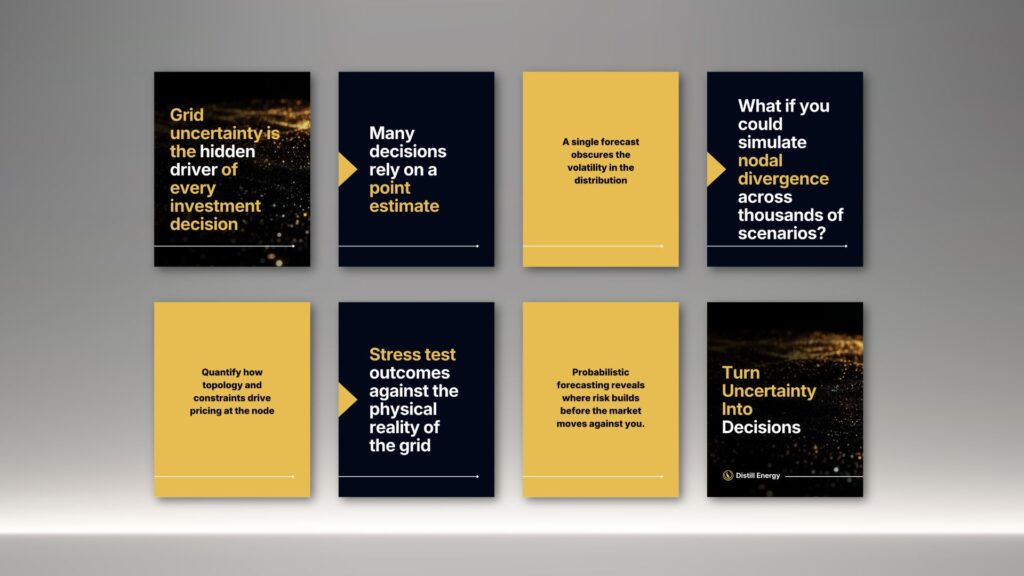
Distills a core idea into a clear, high-signal visual to expand reach and reinforce positioning.

Most power market investments are built on a static forecast.
For traders, developers, and asset owners, a single result is often treated as representative, even though performance depends on how the grid actually evolves.
Asset performance is shaped by how demand shifts and how capacity is built across the network.
These interactions generate a distribution that extends beyond a single result.
When risk is compressed into one number, failure scenarios are excluded from the decision.
Positions can appear viable while containing outcomes that break under specific grid conditions.
Probabilistic forecasting restores that visibility at the node level.
What sits behind the number you are committing capital to?
Concept breakdown
Builds understanding through structured sequencing, extending the narrative across multiple frames.




A single point estimate still drives most decisions in power markets.
Workflows are structured to deliver that value.
They are designed to produce an output that is easier to communicate and act on within a complex environment.
That simplification removes critical information.
The grid does not resolve to a single outcome.
It produces a range of possible states shaped by physical constraints, topology, and evolving demand.
The challenge is representing uncertainty in a way that preserves how the grid behaves.
Probabilistic forecasting represents outcomes as a range, enabling decisions to be evaluated across the states the grid can produce.
Explore how uncertainty can be modeled before decisions are made.
Expanded analysis (Article)
Written on behalf of Distill Energy, this long-form piece uses copywriting to deepen the narrative, add context, and support credibility and long-term positioning.

Turning grid uncertainty into investment decisions
By David Kozak
Most decisions across power markets start with a point estimate, but grid uncertainty modeling reveals how those outcomes vary. A price, a return, or a capacity figure becomes the number that gets approved and acted on, often serving as the basis for moving a deal forward or committing capital. That number creates a veneer of certainty, treating inputs as fixed quantities even though they are shaped by cross-variable dependencies across demand, supply, policy, and infrastructure.
The grid is inherently non-linear, as changing topology and localized conditions shape how outcomes materialize at specific nodes. Price formation can diverge sharply from aggregate metrics under these conditions, with outcomes driven by the underlying mechanics of how the grid operates. A point estimate strips away market context and presents a single outcome, leaving the scenarios that drive volatility and performance obscured from the view used to justify the decision.
Where point estimates break
Let’s say you’re told an asset will generate $1.2 million over the next 10 years. The number meets the investment threshold and fits within the model, so it becomes the basis for structuring trades and resource allocation. That figure is treated as representative of a single future, even though it reflects a constrained set of assumptions about system evolution.
Those assumptions depend on how fundamental drivers evolve over time, and small changes in those drivers can shift outcomes in ways that are not captured in a single estimate. A slight tweak in one driver can alter pricing behavior at specific nodes, especially when congestion or curtailment begins to shape revenue.
The result is a distribution of possible outcomes where the estimate obscures the underlying uncertainty. A project that appears viable at that level can include scenarios that become underwater in specific market conditions, particularly when nodal price dynamics take hold. These outcomes are embedded in how the grid operates and become visible as tail events materialize.
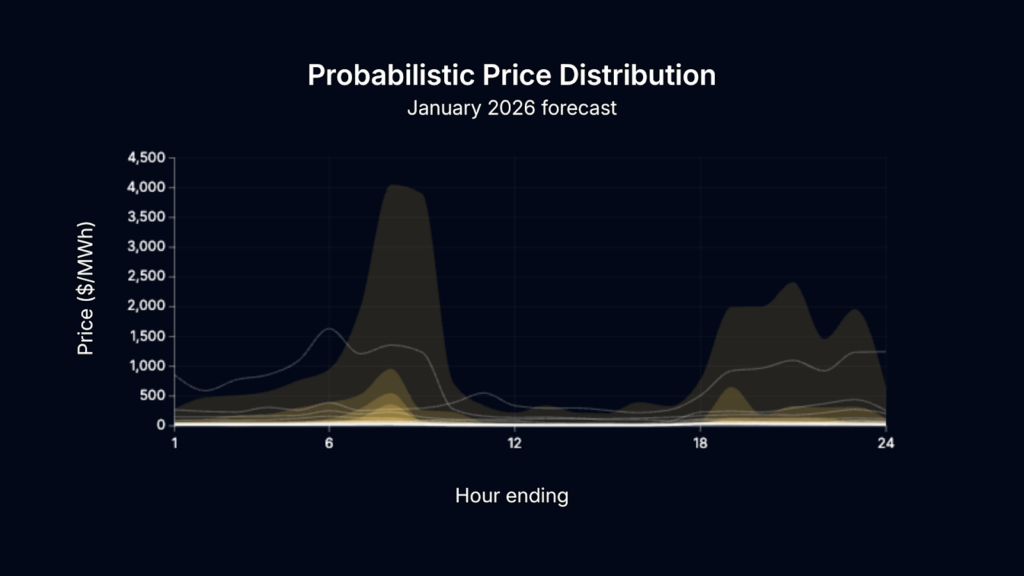
Interact with the model to see how the $1.2 million estimate varies across percentiles and scenarios.
Non-linear risk across the grid
The same forces that compress the risk profile of a single asset become more pronounced across a forward evolving grid, where outcomes are shaped by cross-variable dependencies and do not follow from isolated inputs. Load growth and generation buildout evolve alongside changing topology, and their interaction determines how congestion and curtailment emerge across specific nodes.
These interactions are inherently non-linear, meaning a small change in one driver can lead to a disproportionate shift in outcomes. A localized constraint can alter power flows, reshape congestion patterns, and change how value is realized across an asset or portfolio. Pricing at nodal resolution reflects these shifts directly, with locational marginal prices (LMPs) responding to how conditions evolve across the network.
Traditional approaches struggle to capture this behavior because they evaluate changes in isolation, while the grid responds to combined effects that amplify across the system. As these effects accumulate, results expand beyond the range implied by a single estimate, producing price movements and revenue impacts that reflect how the grid operates under real dynamics.
Grid uncertainty modeling in practice
A risk-aware approach to decision-making treats each forecast as a set of possible outcomes, where uncertainty is represented directly, quantifying how your portfolio responds as load and capacity shift across the grid. This framework makes it possible to move beyond a single projected value and examine how outcomes distribute across different paths the grid can take as load and capacity evolve.
Working within this framework shifts the focus toward identifying failure scenarios and understanding how often they occur. Outcomes can be evaluated based on how they behave when constraints tighten, how frequently scenarios become underwater, and how revenue responds as conditions change at the node level. This creates a clearer view of price risk and revenue sensitivity as it emerges across the grid.
Simulating planning scenarios in this way provides a structured method for evaluating positions prior to resource allocation, allowing decisions to be informed by how outcomes develop across a range of possible futures.
Simulating outcomes before capital is committed
Imagine working in an environment where you can test model sensitivity against the same forces that drive outcomes in the grid, allowing you to simulate how a position performs as load growth and capacity expansion evolve over time. Scenarios can be run to reveal how congestion and curtailment risk develop, giving a clear view of how pricing and revenue respond under different grid states. Changes to key inputs can be traced through the network to understand how they influence results at the node level, showing how shifts in demand or generation reshape outcomes as they move across the system.
Simulation at this level allows positions to be tested before resource allocation, providing a way to identify where risk concentrates and how outcomes unfold across a range of scenarios. High-resolution modeling captures these effects at nodal level, with a cloud-native OPF solver enabling lightning fast simulation across many possible futures. Distill Energy provides this capability by modeling how the grid evolves and how those changes affect assets, portfolios, and long-term positioning.
How does your portfolio perform when the grid moves against your base case assumptions?
Sign up for access to evaluate nodal performance across thousands of scenarios before those risks materialize.
Full content package developed for Distill Energy.
A structured approach to translating technical thinking into clear messaging that supports positioning and sustained audience growth.
If you’re looking to sharpen how your offering is understood and adopted, get in touch.