
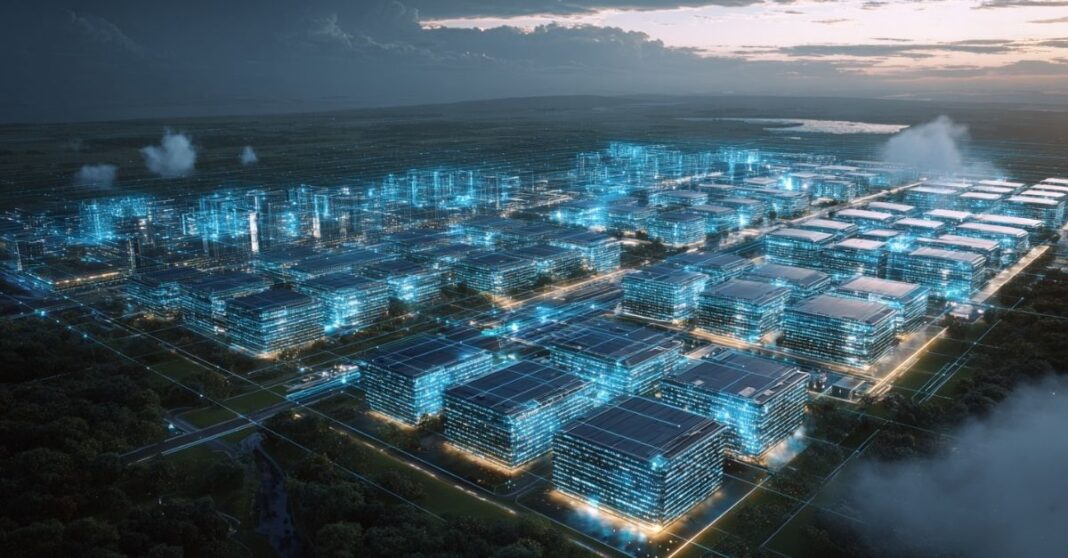

The race to build artificial intelligence infrastructure has reached a new phase. After years of consolidating cloud power and GPU access among a handful of hyperscalers, startups are now claiming their share of the grid. Anthropic’s $50 billion move to construct U.S.-based data centers signals a shift toward private AI infrastructure designed to serve enterprise demand and national capacity at once.
This expansion starts with custom facilities in Texas and New York, developed in partnership with Fluidstack, a GPU cloud platform serving Meta, Midjourney, and Mistral. The project will create 800 permanent jobs and more than 2,000 construction roles. Anthropic CEO Dario Amodei said the new sites will “help us build more capable AI systems that can drive those breakthroughs, while creating American jobs.”
→ Explore more developments signaling industry disruption.
Funding Scale
Anthropic’s $50 billion initiative arrives as OpenAI pursues more than $1.4 trillion in long-term infrastructure commitments. Amazon, Google, and Nvidia have all tied capital to AI capacity, transforming data centers into the strategic currency of this era. The difference here is Anthropic’s focus on independence. Its expansion follows Amazon’s $11 billion dedicated campus in Indiana, now fully operational, while many competitors are still in planning stages.
Domestic Capacity
Government pressure to secure U.S.-based compute is growing. Anthropic’s build-out arrives as policymakers debate whether tax incentives under the CHIPS Act should extend to AI data centers and grid components. OpenAI’s request for such inclusion, later retracted, exposed how fragile funding models could become if public support lags behind private expansion. Anthropic’s decision to proceed without those assurances strengthens its image as a stable infrastructure anchor.
Market Position
Serving over 300,000 businesses, Anthropic has seen its enterprise accounts generating more than $100,000 annually grow sevenfold in the past year. The company projects to break even by 2028, well ahead of OpenAI’s estimated losses that same year. Fluidstack’s involvement ensures customized GPU capacity on rapid timelines, allowing Anthropic to accelerate deployment and secure control over its computational environment.
Competitive Dynamics
The infrastructure race now defines AI competition. OpenAI’s trillion-dollar plan raised concerns about national power limits and industrial supply chains. Anthropic’s measured but significant scale offers an alternate model focused on targeted growth and speed of execution. For investors, that may mark a turning point in how capital efficiency is valued against ambition.
Next Indicators
By 2026, the Texas and New York sites will go live, establishing benchmarks for localized AI infrastructure delivery. Success here could influence how startups balance hyperscaler dependence with private control. Watch for new joint ventures between AI firms and regional utilities as power security becomes an investment criterion.
Strategic significance
Anthropic’s $50 billion initiative positions AI data centers as both industrial and strategic assets. The focus on speed, locality, and autonomy suggests startups may now play roles once reserved for governments or major clouds. If timelines hold, this will set new norms for how deep-tech firms anchor domestic capacity while sustaining rapid product cycles. The next test lies in whether private infrastructure can scale without fracturing under the weight of national expectations.
Reference
Sigalos, M. (2025, November 12). Anthropic to spend $50 billion on U.S. AI infrastructure, starting with Texas, New York data centers. CNBC. https://www.cnbc.com/2025/11/12/anthropic-ai-data-centers-texas-new-york.html